CloudTalk
Call center software for sales & support
Starting price
$25/mo
Budget tier
Mid-range
Complexity
Intermediate
Integrations
40+
Best for
Sales and support teams that need call-center features and global numbers.
Overview
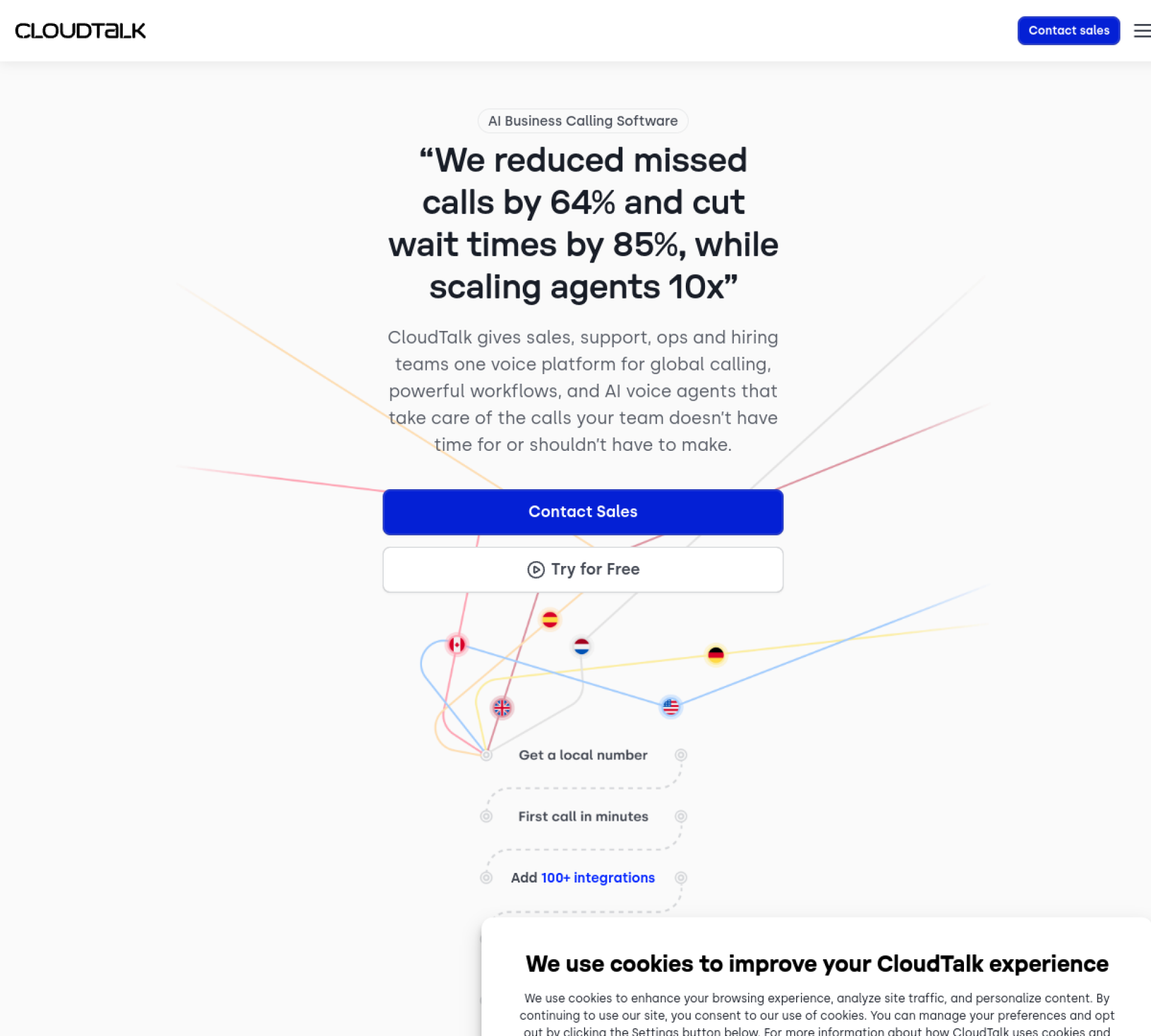
CloudTalk is a European cloud call-center platform with smart and power dialers, international numbers, IVR, and deep CRM integrations. It suits sales and support teams that want call-center features without on-prem hardware.
Founded in 2018 and based in Bratislava, Slovakia, CloudTalk competes in the phone system & dialers category. It is approachable, with a short learning curve, and it is mid-priced for the value it delivers ($25/mo). In practice, CloudTalk is best for sales and support teams that need call-center features and global numbers.
Teams reach for a sales phone system when calling is a core motion. Reps work through call lists with a dialer, use local numbers to lift pickup rates, and rely on automatic logging so every conversation lands in the CRM. The goal is simple: more live conversations per rep per day, with less manual busywork around each one.
Key features
Here is what CloudTalk brings to the table, and what each capability means in practice.
Power / auto dialer
A power dialer calls through a list automatically, dialing the next prospect the moment a rep finishes. Removing the seconds spent manually dialing between calls adds up to dozens of extra conversations over a day.
Local presence numbers
Local presence displays a local area code to the person being called, which measurably increases pickup rates. People are simply more likely to answer a number that looks local than an unfamiliar long-distance one.
Call recording
Records and stores calls automatically for coaching, compliance, and follow-up. Recordings become a searchable library managers use to onboard new reps and to settle exactly what was promised on a deal.
Voicemail drop
One-click voicemail drop leaves a pre-recorded message and immediately moves the rep to the next call. It reclaims the time reps would otherwise spend repeating the same voicemail dozens of times a day.
IVR & call routing
IVR menus and call routing send inbound callers to the right person or team automatically. It keeps prospects from bouncing around and ensures hot inbound calls reach a rep fast.
SMS / texting
Two-way SMS lets reps text prospects from the same platform they call from, with messages logged to the CRM. Texting often gets a faster reply than email for confirmations, reminders, and quick follow-ups.
CRM integration
Tight CRM integration logs every call, text, and outcome against the contact automatically. Reps never have to remember to record activity, and the data stays clean enough to actually report on.
API & webhooks
An API and webhooks let teams automate workflows and pipe data into their own systems and dashboards. For RevOps teams, this is what makes the tool a building block rather than a silo.
Priority / 24-7 support
Priority or 24/7 support, often with a dedicated contact, is available for teams that cannot afford to wait on a ticket. It matters most once the tool is mission-critical to daily selling.
Who it's for
CloudTalk is built for startups, mid-market teams and enterprises. It is a particularly strong fit for sales and support teams that need call-center features and global numbers, and reps will find it approachable, with a short learning curve.
It is less of a fit in a few cases. It may be more than solo users with very basic needs require, and if higher tiers needed for best features is a dealbreaker for you, it is worth weighing against the alternatives before committing.
Typical users include high-activity SDR teams dialing all day, inside-sales reps who close over the phone, and support or success teams that need calling wired into the CRM.
Integrations & ecosystem
CloudTalk connects with around 40+ tools, including HubSpot, Salesforce, Pipedrive, Zendesk and Intercom. That matters because a sales tool is only as useful as the rest of your stack: the tighter it plugs into your CRM and workflow, the less manual data entry your reps do and the cleaner your reporting stays.
An open API and webhooks mean CloudTalk can also be wired into custom workflows, internal dashboards, and the rest of your data stack, which is what RevOps teams look for when they want a tool to act as a building block rather than a silo.
Pricing & value
CloudTalk is mid-priced for the value it delivers. From ~$25/seat/mo; power/smart dialer on higher tiers. The value case is strongest for the teams it is built for: when that is you, the time saved and meetings booked tend to outweigh the cost. If it is not, a lighter tool may serve you just as well for less. As always, the sticker price is only part of the story: weigh onboarding time, the tier your team will realistically land on, and any add-ons before comparing it against the alternatives.
Strengths & limitations
On the strengths side, CloudTalk stands out for a few reasons: power/smart dialers and IVR; large catalog of international numbers; and strong CRM and helpdesk integrations.
The trade-offs are worth knowing before you commit: higher tiers needed for best features; occasional call-quality reports; and setup takes some time. None of these are necessarily dealbreakers, but they are the points to pressure-test during a trial.
The bottom line
CloudTalk delivers call center software for sales & support, and it earns its place across startups, mid-market teams and enterprises. The standout reasons to pick it are clear, power/smart dialers and IVR chief among them, while the main thing to weigh is that higher tiers needed for best features. If that trade-off fits your situation, CloudTalk is well worth a trial.
Pros & cons at a glance
Pros
- Power/smart dialers and IVR
- Large catalog of international numbers
- Strong CRM and helpdesk integrations
Cons
- Higher tiers needed for best features
- Occasional call-quality reports
- Setup takes some time
Features at a glance
Pricing
$25/mo
From ~$25/seat/mo; power/smart dialer on higher tiers
Pricing verified against the vendor's site in 2026.
Frequently asked questions
How much does CloudTalk cost? +
CloudTalk starts at $25/mo. From ~$25/seat/mo; power/smart dialer on higher tiers.
Does CloudTalk have a free plan? +
CloudTalk does not offer a permanent free plan, though its pricing (from ~$25/seat/mo; power/smart dialer on higher tiers) often includes a trial to evaluate it first.
What is CloudTalk best for? +
CloudTalk is best for sales and support teams that need call-center features and global numbers. It is a particularly strong fit for startups, mid-market teams and enterprises, and reps will find it intermediate to adopt.
What does CloudTalk integrate with? +
CloudTalk integrates with around 40+ tools, including HubSpot, Salesforce, Pipedrive, Zendesk and Intercom.
What are the best CloudTalk alternatives? +
Leading alternatives to CloudTalk include PhoneBurner, Kixie and Close. You can see the full list, compared side by side, on our CloudTalk alternatives page. See alternatives →
Similar tools
CloudTalk in our articles
Guides and comparisons on TheSharkStack that feature CloudTalk.
- Guide
The 5 Best Aircall Alternatives for 2026
Jun 2026 - Comparison
Allo vs CloudTalk: Which Sales Phone System? (2026)
Jun 2026 - Guide
The 5 Best Dialpad Alternatives for 2026
Jun 2026 - Guide
The 5 Best JustCall Alternatives for 2026
Jun 2026 - Comparison
Best AI phone systems for sales teams (2026)
Jun 2026 - Comparison
Best cold calling software for SMB sales teams (2026)
Jun 2026